Woods Hole Oceanographic Institution as US Navy Defense Contractor

(Submarine warfare)

News story:

September 28, 2026

US Underwater Drone Seized in Hormuz

Iran’s Islamic Revolutionary Guard Corps (IRGC) Navy announced on Sunday that it had seized an advanced US autonomous underwater vehicle in the Strait of Hormuz, saying the vessel had been conducting espionage operations.

According to a statement carried by Iranian state media, the IRGC Navy identified the captured vehicle as a Remus 600, an autonomous underwater vehicle used by the US military.

The IRGC said its forces intercepted the vehicle during a “coordinated and complex operation” involving intelligence surveillance and electronic warfare capabilities.

The vehicle was subsequently taken into Iranian custody and is now being examined by IRGC Navy specialists.

Iranian state broadcaster IRIB reported that specialists are working to retrieve data stored inside the captured vehicle.

Source: https://www.palestinechronicle.com/iran-seizes-us-remus-600-underwater-drone-in-hormuz-releases-footage/


----------------------------------------------------------------------------------------

From Wikipedia


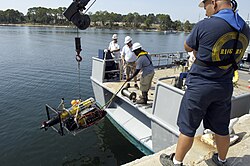
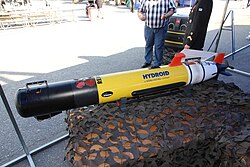
./WHOI_US_Navy_html_2d5ce084_1790637812706 Finnish Navy ./WHOI_US_Navy_html_b0e30c99_1790637833007

The REMUS (Remote Environmental Monitoring UnitS) series is autonomous underwater vehicles (AUVs) made by the Woods Hole Oceanographic Institution and designed by their Oceanographic Systems Lab (OSL). More recently REMUS vehicles have been manufactured by the spinoff company Hydroid Inc, which was a wholly owned subsidiary of Kongsberg Maritime.[1] Hydroid was acquired by Huntington Ingalls Industries (HII) in March 2020.[2] The series is designed to be low cost, they have shared control software and electronic subsystems and can be operated from a laptop computer.[3] They are used by civilians for seafloor mapping, underwater surveying, and search and recovery as well as by several navies for mine countermeasures missions.

Models

There are a number of variants of the REMUS; all are torpedo-shaped vessels with reconfigurable sensors.

REMUS 6000

The largest model is the REMUS 6000 at 3.84 metres (12.6 ft) long and 71 centimetres (28 in) in diameter; it is named after its maximum diving depth of 6000m.[4] It can travel at speeds of up to 5 knots (9.3 km/h) and has an endurance of up to 22 hours.[4] It was developed through cooperation between the Naval Oceanographic Office, the Office of Naval Research, and the Woods Hole Oceanographic Institution (WHOI).[5]

Source: https://en.wikipedia.org/wiki/REMUS_(vehicle)